



















 Spanish News Today
 Alicante Today
 Andalucia Today

 There is no point fighting the Spanish climate and trying to plant sappy flowers with soft leaves in order to create dry landscapes which will survive the hot summer: it's better to choose plants which can resist the extreme heat of summer and survive with little or no water.
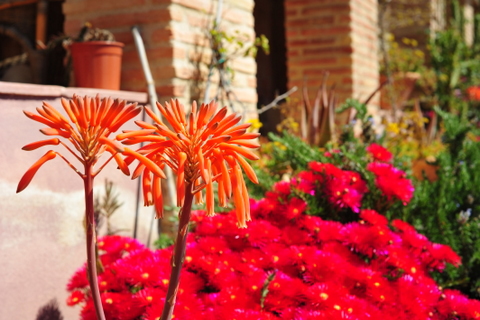
Aloe Saponaria is an aloe which can be found in rustic country areas, coating the ground with a dense, spiky layer, bearing orange flowers in spring and providing ground cover throughout the year.
{image3They propagate by creating offsets, via stolons, which is almost like an umbilical cord forcing through the ground to emerge with a baby plant on the end, a perfect copy of its parent, and they continue to send out one perfect copy after another, forming a solid mass if left unchecked.
Planted singly, they soon spread to form an attractive clump of several plants, and if the parent becomes too large, or looks tatty, simply pull; it out and the offspring will soon fill the space.
Propagating couldnt be easier, as the young plantlets detach easily from the parent, lifting the young plant with a fork will usually detach it completely, and a sharp tug will usually do the trick should it still be joined. Normally once roots are set the stolon withers away and the plant is free to grow on its own, and once you have acquired a single plant, it takes very little time for them to begin multiplying.
Planted in groups, they form attractive feature plants for rocky areas, but are also extremely useful for ground cover, preventing erosion if used to support banks, and will tolerate shade and semi-shade as well as full sun.
Theyre also an extremely useful filler to be used in spaces whilst waiting for something else to grow. We often underplant them in the full knowledge that theyll be taken out once something else grows to size as theyre so forgiving and transplant really easily.
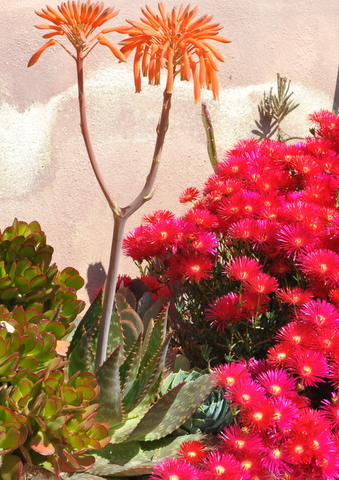 In spring they bear attractive orange flower spikes, which soar elegantly above the plants, and if faced with extreme drought conditions, will assume a burgundy hue, but dont worry, once the autumn rains begin they soon rehydrate and resume their characteristic dark green appearance.
When transplanting young plants they often shock and assume this burgundy hue, but come the rains of autumn and they soon perk up.
Don't put these anywhere near a watering system as they take in too much water and growth is leggy and weak.
Ongoing care
After flowering, remove flower spikes. Either cut off close to the plant whilst still green, or allow to dry out completely, in which case they detach easily from the plant.
To encourage production of young plants, remove lower leaves.
As the plant grows upwards, the lower leaves shrivel and die, a natural process. Removing them stimulates more young production, and makes the plant look tidier, although often it is better to remove the central parent plant after 3 years or so and allow the young to take its place, as they can become quite large if receiving water and allowed plenty of space.
In cases such as these, remove the brown leaves and plant the stem deeply to bury it up to the point at which the healthy leaves begin, and they will soon send out new growth.
Normal height, around 40cm, with a spread of 60cm per plant.